

I used to know my love language the way I knew my star sign and my Myers-Briggs type (which I still low-key love TBH); with the kind of casual certainty that comes from having done a quiz and had the result confirmed by everyone around you. Quality Time; that was me. I said it at small groups, mentioned it early in my relationship with Chrissy, handed the framework to people I cared about like it was useful equipment and used it in my first few years of being a relationship therapist. I believed, genuinely, that Gary Chapman had cracked something real about human beings and how they connect.
I was in my twenties, studying counselling, inside a church, and nobody told me to read it critically. Nobody told me to read it at all, really; it was just there, in the water. Premarital counselling and marriage sermons. Relationship advice columns in Christian magazines. Women’s Bible study. The five love languages were presented as discovered truth, the kind of framework that had been tested and verified and handed down. A tool, a key and something that explained why some relationships felt effortless and others felt like you were always just slightly missing each other.
I did the quiz multiple times, in different seasons, checking whether my primary language had shifted. I used the language casually and sincerely, the way you use any framework that seems to map onto real experience. It felt empirical, it felt like science, or at least close enough.
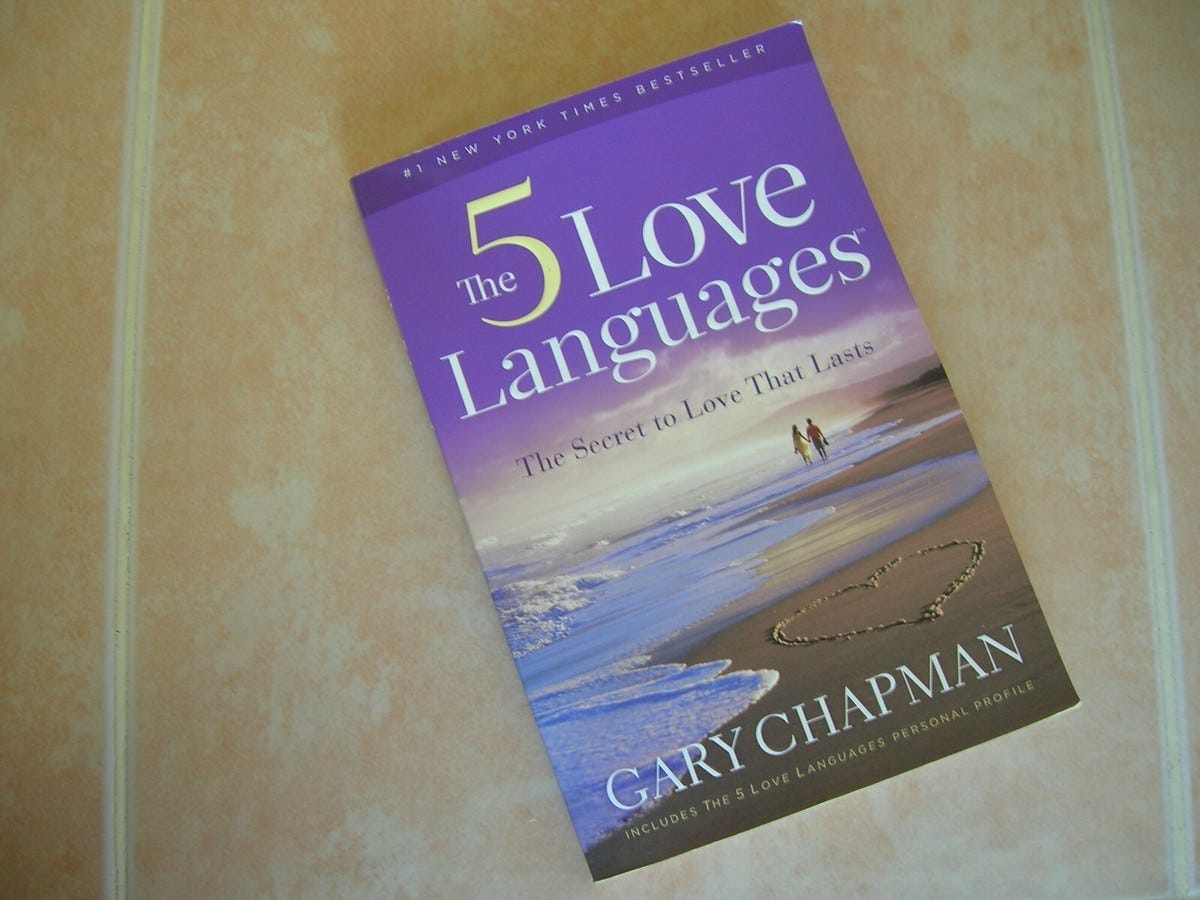
What I didn’t know and what most people don’t know is that Gary Chapman is not a psychologist. He’s not a researcher, not a therapist, not a scientist of any kind. He’s a Baptist minister who wrote a pastoral manual for heterosexual Christian couples and watched it accidentally become one of the best-selling relationship books in the world.
That’s not a small detail. That’s the whole thing.
The Man Behind the Quiz
Let’s start with who Gary Chapman actually is, because the framing around this book has always been slightly slippery on that point.
Chapman holds degrees from Moody Bible Institute and Southwestern Baptist Theological Seminary. He has a PhD in adult education, not psychology, not counselling, not any clinical field. He is, and has always been, a Baptist minister and pastor.
The Five Love Languages was published in 1992 by Northfield Publishing, a Christian publishing house. It was written explicitly for Christian heterosexual married couples, drawing on Chapman’s decades of pastoral counselling notes. That’s where the five categories came from; not from research, not from a validated methodology, not from peer review. From a pastor’s notebooks.
None of that is automatically disqualifying. Pastoral wisdom can have value and noticing patterns in human behaviour is useful. But the problem is that the book was never clearly positioned as what it actually was; a theologically grounded, culturally specific framework for a very particular kind of relationship, written by a minister, for his congregation’s marriages.
Instead, it crossed over. It landed in secular bookshops and mainstream therapy offices and Instagram bios and corporate team-building workshops. The “Dr.” in front of Chapman’s name did a lot of heavy lifting in that transition, leading many readers to assume mental health credentials that simply weren’t there. Once it was in mainstream culture, the original context largely disappeared. Most people who’ve done a love languages quiz have no idea they’re working from a Baptist pastor’s notes.
That matters enormously for everything that follows.
The Science Problem
The thing about the five love languages as a psychological theory is that there isn’t much science behind it.
Multiple researchers have attempted to validate the framework and found it wanting. A 2024 paper in Current Directions in Psychological Science outlined the theory’s significant weaknesses and one of the most damaging findings is that the central premise doesn’t hold up. The matching hypothesis and the idea that your relationship satisfaction depends on your partner expressing love in your specific language hasn’t been supported by evidence.
Research has found that expressions of all five love languages were associated with relationship satisfaction regardless of a person’s stated preference. In other words, everybody benefits from all of them, which rather undermines the entire point of identifying which one is “yours.”
The matching premise; that your relationship depends on your partner speaking your specific love language hasn’t been supported by evidence. Turns out everybody benefits from all of them.
What Chapman did was observe patterns in his pastoral counselling, assign them to five categories, give the categories memorable names, and publish the result as a universally applicable model of human connection. That’s not discovery, that’s classification and it’s built on a sample of Christian heterosexual married couples in crisis; possibly the least generalisable sample imaginable.
This doesn’t mean the framework is useless for every single person who’s used it. People find meaning and language and a starting point for conversations they didn’t know how to have. That’s real, but it’s worth knowing what you’re actually working with which is a framework someone constructed, not a law of human psychology that was uncovered. It was never peer-reviewed. It was never validated across diverse populations. It was never designed for you, unless you are a straight, cisgender, Christian married person navigating a struggling marriage in 1990s America.
There’s also something worth naming about what it means when an unvalidated framework becomes this embedded in therapy spaces. Counsellors and psychologists have used love languages in sessions, in workshops, in psychoeducation handouts. It has the aesthetic of clinical credibility; the clean categories, the quiz format, the professional-sounding language all without the substance. And because it feels useful, because clients nod along and say yes, that’s me, it doesn’t get questioned. Feeling recognised is not the same as being accurately described. A horoscope can make you feel seen. That doesn’t make it a personality theory.
The love languages framework gets a pass in clinical spaces that genuinely rigorous frameworks don’t always get, in part because it’s non-threatening. It doesn’t challenge power dynamics. It doesn’t name abuse. It gives people something to work on; a communication project, a love tank to fill that keeps the relationship as the goal and the individuals as the variables to be adjusted. For a pastor trying to preserve marriages, that’s a feature. For a therapist trying to help someone understand themselves and their relationships clearly, it’s worth interrogating.
The Gender Problem
Even if you set the science aside, even if you’re willing to use it as a loose and imprecise but conversationally useful tool; the gendered assumptions baked into the original framework are not incidental. They’re structural.
The Five Love Languages was written for heterosexual married couples, which means it uses gendered quizzes, gendered scenarios, and gendered instructions throughout. The LGBTQ+ reader is simply not there. Queer couples, non-binary people, poly relationships; anyone outside the straight cisgender monogamous married dyad has to translate the entire framework into their own context which is a framework that was never written with them in mind and in several places actively contradicts their existence.
But it goes further than exclusion. Chapman’s instructions to women within the framework are worth sitting with directly. Women are told not to nag their husbands. Women are instructed to verbally affirm their husbands for doing basic domestic tasks like loading the dishwasher, mowing the lawn all because words of affirmation is a love language and your husband might need it.
There is no equivalent instruction to husbands about affirming their wives for the significantly larger share of domestic and emotional labour they are statistically carrying. The emotional architecture of the model places the labour of relational maintenance disproportionately on women, which isn’t surprising given who wrote it and who it was written for, but is worth naming clearly because this material has been handed to people in therapy offices as though it’s neutral science.
It isn’t neutral. It was written by a conservative Baptist minister who believes men and women have different, complementary, God-given relational roles. That theology is not a footnote. It’s the load-bearing wall.
How It Gets Weaponised
This is the part I want to be precise about, because it matters most for the people reading this.
The five love languages framework, in high-control religious contexts, does not just reflect problematic assumptions. It becomes a tool and the way it gets used is specific and documented.
Physical touch as a love language, within fundamentalist Christian marriage theology, becomes a mechanism for coercing sexual compliance. If your husband’s love language is physical touch, and you are a wife who has been taught that meeting your husband’s needs is your spiritual responsibility, and a pastoral framework tells you that love means speaking the other person’s language; well you can see where that logic goes.
Chapman himself, in documented pastoral advice, told a woman in an emotionally abusive marriage to meet her husband’s love language of physical touch through sexual intimacy, despite her clear distress. The priority was marriage preservation. Her safety and wellbeing were secondary.
In 2019, Chapman sent an email to his subscribers presenting a woman’s return to her abusive husband as a positive outcome. A success story. A marriage saved.
More broadly, the framework’s logic that relationship problems arise from not expressing love in the right language shifts responsibility in ways that are genuinely dangerous in abusive dynamics. If things are bad, and the model says things are bad because love isn’t being communicated correctly, then the question becomes “Whose love language isn’t being met, and who isn’t trying hard enough?” That framing places the weight of resolution on both partners equally, which sounds fair until you apply it to a situation where one person is causing harm. Suddenly the person being harmed is implicated in the failure. They weren’t speaking the right language. They weren’t filling the love tank.
I have sat across from people in my practice who were handed this framework in church, in premarital counselling, in pastoral meetings, and who used it for years to make sense of relationships that were hurting them. The framework gave their pain a name that wasn’t abuse. It gave them a project to learn his love language, speak it better, try harder; instead of the clarity they actually needed.
The insidious thing about this is how tidy it sounds. Love languages gives an unhappy relationship an explanation that doesn’t implicate anyone’s character or behaviour. It’s not that he’s controlling or she’s being mistreated; it’s that they’re speaking different languages. Fix the communication, fix the marriage. It’s almost elegant in how completely it sidesteps accountability.
In a religious environment where divorce carries shame and pastoral authority is significant, a framework that says try harder in these five specific ways is going to be received very differently than one that says this relationship may be harming you.
People stayed. People tried harder. People filled love tanks while their own ran empty, because the framework told them the solution was more effort in the right direction, not less tolerance for what was being done to them.
That’s not a neutral outcome. That’s harm with a friendly font and a bestseller badge.
The Homophobia
And then there’s this.
Chapman has published material stating that when a child comes out as gay, disappointment is a common and understandable parental response, and that while parents should “demonstrate” love, they need not approve of “the lifestyle.” He has stated on his podcast that men and women are made for each other as God’s design, and that anything outside that is outside God’s primary design.
Let me be clear about what that means. Gary Chapman; whose framework has been distributed in secular therapy offices, handed to queer people in counselling settings, used in LGBTQ+ relationship workshops by well-meaning facilitators who didn’t look too closely at the source, believes your queerness is outside God’s design. He believes your parents’ disappointment in you is understandable. He has not significantly revised or distanced himself from these positions.
Yet the five love languages has been enthusiastically adopted into queer spaces, adapted for queer relationships, used as common shorthand in communities whose existence Chapman considers a deviation from the divine order. There are entire articles, resources, and workshops about how to apply the love languages framework to same-sex relationships, to polyamorous relationships, to non-binary partnerships. People have done real and genuine work using this language and I’m not dismissing that.
But there is something particular about using a queer-affirming lens to rehabilitate a framework built by someone who would not affirm your relationship’s right to exist and handing that rehabilitated version back to queer people without disclosing where it came from. It’s well-intentioned, but it’s also incomplete. Most of the people using it have no idea. They found a useful-sounding framework, separated it from its author, and got on with their lives. I understand that completely, but knowing it matters.
You are not obligated to throw out every conversation you’ve had using this language. You’re allowed to have found something useful in it. But you do deserve to know whose hands built the tool you’re holding, what they built it for, and what they think of you.
What It Cost to Believe It
I don’t think I wasted the years I spent inside this framework, exactly. I think I was doing what people do inside systems that hand you tools without disclosing their origins; I was using what was available, in the way it was presented, to try to understand myself and the people I loved. There was something in it that felt like being taken seriously. Like my relational needs had a name. Like there was a logic to why connection sometimes worked and sometimes didn’t.
That part wasn’t nothing, but it also wasn’t what I thought it was.
There’s a particular kind of grief that comes with realising the map you were given was drawn by someone who didn’t have your territory in mind. Who wasn’t thinking of you at all when they drew it. Who, if asked directly, would tell you that some of what you are is a deviation from the correct design.
There’s a particular kind of grief that comes with realising the map you were given was drawn by someone who didn’t have your territory in mind.
The five love languages isn’t just a flawed framework. It’s a document of a particular time, a particular theology, a particular vision of what relationships are for, which, in Chapman’s world, is heterosexual monogamous Christian marriage, maintained and preserved at significant cost to the individuals inside it. Everything else is adaptation and approximation. Making do with something that was never built for you.
I’m not telling you to delete the quiz from your phone or go back through every relationship conversation you’ve had and mark it contaminated. I’m telling you to hold it differently. To know what it is and to understand that “words of affirmation” was never a discovery about your essential nature, it was a category a Baptist pastor invented from his counselling notes, and the world decided it was science.
That’s not nothing, but it’s also not what we were told.
What else have you been handed as relationship truth that might deserve a second look at the source?
Looking for more?
I offer therapy for those holding religious trauma, queer folk, and cult survivors in person at my Goulburn, NSW location and online Australia & New Zealand wide. Reach out here.
I also create resources for both survivors and practitioners around religious trauma, high-control systems, recovery and queerness.
I also host a podcast called Beyond the Surface, where I get to chat to the most wonderful humans about their own stories of religious trauma, faith deconstruction and leaving a cult. Its available on all major podcast platforms.
I am also a co-founder of The Religious Trauma Collective (Aus/NZ), a space where you can find support, resources and community.
For a one stop shop for me and my work head here → Anchored Counselling Services
References
Diessner, R., et al. (2024). Weaknesses of the Five Love Languages theory. Current Directions in Psychological Science. Reported via Live Science.
Chapman, G. (1992). The Five Love Languages. Northfield Publishing.
Chapman’s academic and ministerial credentials: Moody Bible Institute; Southwestern Baptist Theological Seminary.
Chapman’s 2019 subscriber email re: woman returning to abusive husband — reported via Substack sources.
Chapman’s statements on homosexuality and parental responses to LGBTQ+ children — documented via Scary Mommy; Chapman’s podcast.
Critique of the framework’s handling of abuse, coercion, gender roles, and LGBTQ+ exclusion: Simply Psychology; Medium.
Ugh. This book wove its way into so much of my landscape. Ugh.
I can’t stress enough how much I hate this book or approach to relationships. It is so irritating how entrenched it has become. Everybody seems to be mentioning their love language at one point or another. Undoing this will need some time but it has to happen.